

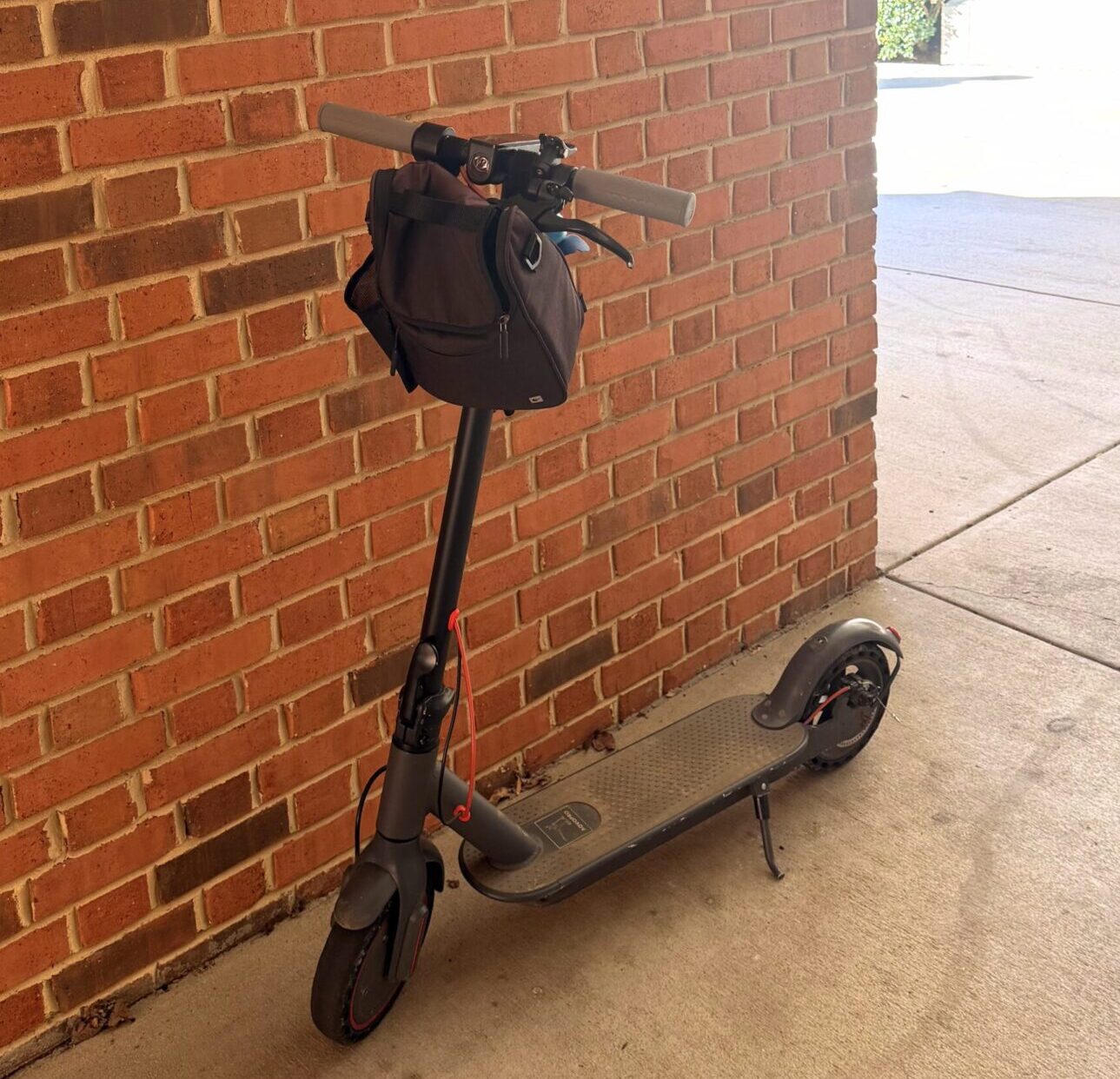
On Feb. 1, Samford’s new motorized scooter policy will go into effect following an increase in community concern regarding the safety and use of electronic scooters. The new policy states that motorized scooters are prohibited from operating outside of roadways and may only be stored or parked in designated university charging stations or bike racks.,
The policy defines motorized scooters as a small, lightweight, motor-powered vehicle designed for individual transport, typically with two wheels and a standing platform. The policy makes a distinction between motorized scooters and approved mobility-assistive devices, with the latter not being subject to the new policy’s restrictions.
The policy states that motorized scooters must be registered with Transportation Services, and students who possess a scooter are required to pay a registration fee. The policy does not specify the monetary amount of the fee. The policy also acknowledges that motorized scooters are recognized as vehicles in Alabama and, therefore, must obey the same traffic rules as vehicles on campus.
Other universities across Alabama have similar policies in place. At the University of Alabama, students must similarly register their motorized scooters and may only operate the scooters on the roadways. The University of Alabama has an additional rule about personal protective equipment, stating that all riders must wear helmets. Students at The University of Alabama at Birmingham are also only permitted to operate scooters on roadways, and they cannot be parked outside of designated spaces. In contrast to the University of Alabama and Samford University, UAB does not require vehicle registration for scooters since it is an open campus.
The policy was primarily created by Samford’s Office of Finance and Business Affairs, but the office did work with several other departments, including the Department of Public Safety, Transportation Services, Residence Life and SGA, to name a few. SGA president Caleb John stated that although the policy was ultimately developed and finalized by university staff, the SGA executive board was asked to give its opinion on a working draft of the policy.
“Our focus was on how the policy could support students’ experience on campus … We shared diverse reactions and offered suggestions that we believed reflected students’ needs,” John said.
After the policy was released via email, many Samford students praised the decision on Fizz, an anonymous social media platform. Some students have gone so far as to post photos of individuals who would be “breaking” the new policy, ignoring the fact that it does not go into effect until February 1st.
Reactions have been mixed among athletes, who largely make up the scooter-using population at Samford. Junior track athlete Arthur Chitty said that banning scooters from campus entirely would have been a better idea than instituting a new policy.
“Our campus is not that big that you need an electric scooter to get around. Whether you’re an athlete or you’re a regular student… it’s just a waste of money, and it’s a hassle to keep up with,” Chitty stated.
Junior, Grace Engel, a member of the Samford Women’s Golf Team, said that she has been using a motorized scooter to traverse campus since last spring, and she is frustrated by the new policy, feeling that for athletes who are already pressed for time, the new policy makes staying on schedule even harder.
Regarding the fact that scooters and vehicles will now be sharing the roadway, Engel also stated, “I feel like that’s almost a little more dangerous for the people that are riding scooters. As a driver and a scooter rider… I know it puts the drivers in an uneasy spot, and also puts the people riding scooters in an uneasy spot.”

Staff Reporter