

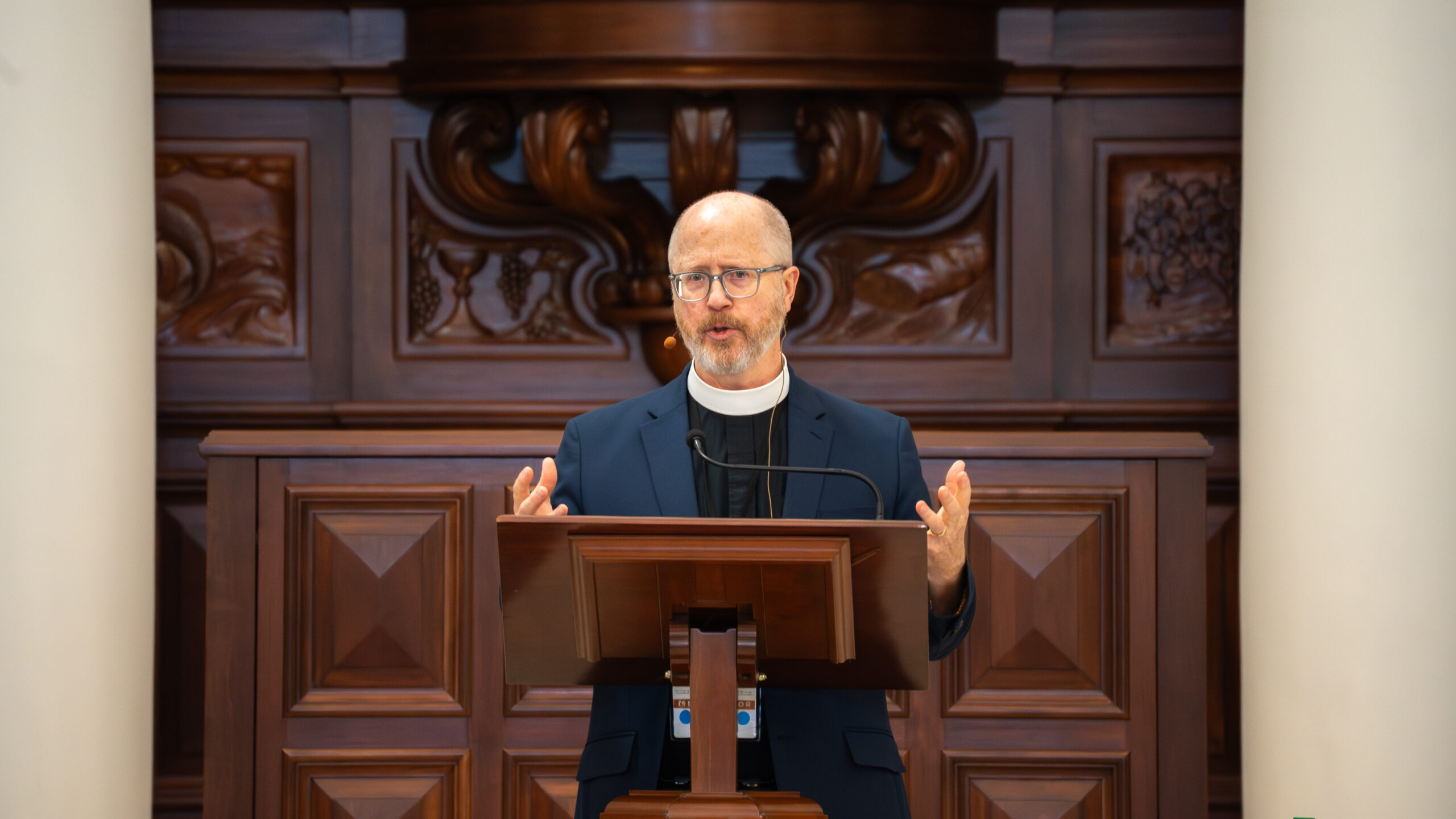
As Samford’s undergraduate students begin the first week of their spring semester, students of the Beeson Divinity School, among other attendees (110 at last count), spent their time at the Nicaea Pro Ecclesia Conference.
This year marks the second time that Samford has hosted this event, and it will be hosted at the divinity school next January, as well.
The conference was from Monday, Jan. 12, 2026, to Wednesday, Jan. 14, 2026. The first day of sessions took place at Holy Trinity and Holy Cross Greek Orthodox Cathedral in Birmingham, with the remaining two days occurring at Samford’s Beeson Divinity School.
The conference gave attendees opportunities for open discussion of the history of the Nicene Creed and its relevance in today’s traditions of Catholicism, Orthodoxy and Protestantism.
Another topic of discussion was the doctrine of the Trinity seen within the creed and how it has shaped the unified doctrines of the Church.
The goal of the conference was to create an ecumenical, or interdenominational, space where believers and leaders of different backgrounds could discuss their similarities and differences in the way they live out the contents of the creed in their daily lives.
The keynote speakers at this event were Marcus Plested, Matthew Levering and Kevin Vanhoozer.
Plested is a professor at Marquette University, teaching Greek Patristic and Byzantine Theology, as well as an author to four books, including “Wisdom in Christian Tradition: The Patristic Roots of Modern Russian Sophiology”.
Levering is a prolific author, co-editor of a number of different journals such as the International Journal of Systematic Theology and member of Evangelicals and Catholics Together.
Vanhoozer taught at Wheaton College and Graduate School and the University of Edinburgh for a number of years and edited many papers and books like “The Cambridge Companion to Postmodern Theology”.
These three speakers were joined by panelists Fr. Gregory Edwards, Abp. Joseph Marino, Bp. Glenda Curry, Michael Root, Collin Hansen, Stefana Laing, Timothy George and Sarah Gronberg.
The days consisted of different sessions, sermons and teachings, times of prayer and worship, as well as moments of fellowship at banquets or luncheons.
Doug Sweeney, Executive Director of the Center for Catholic and Evangelical Theology, played a key role in the planning and execution of this conference, along with many others that work at Beeson.
When discussing the outcome of the event, he expressed his excitement with the unity that it seemed to bring.
“It was exciting that Christians from across these varied church traditions worshiped together in a way that was centered on our common faith as it was summarized at the Council of Nicaea and in the Nicene Creed,” said Sweeney.
Sweeney’s work in putting together this conference as well as with the center provided opportunities for him to speak on what made this year in particular special.
“This conference was special in that we had a lot of new faces join us this year. The work of the Center is expanding these days and people are feeling a lot of excitement about its potential in the world of ecumenism,” said Sweeney.
Overall, the conference worked to spread the unity of the Church and commonalities in their Nicene (Trinitarian) faith. Groups of Catholic, Eastern Orthodox and Protestant clergy, theologians and members were able to commune and discuss, not just what makes them unique, but what brings them together under the name of God.
Arts & Life Editor