

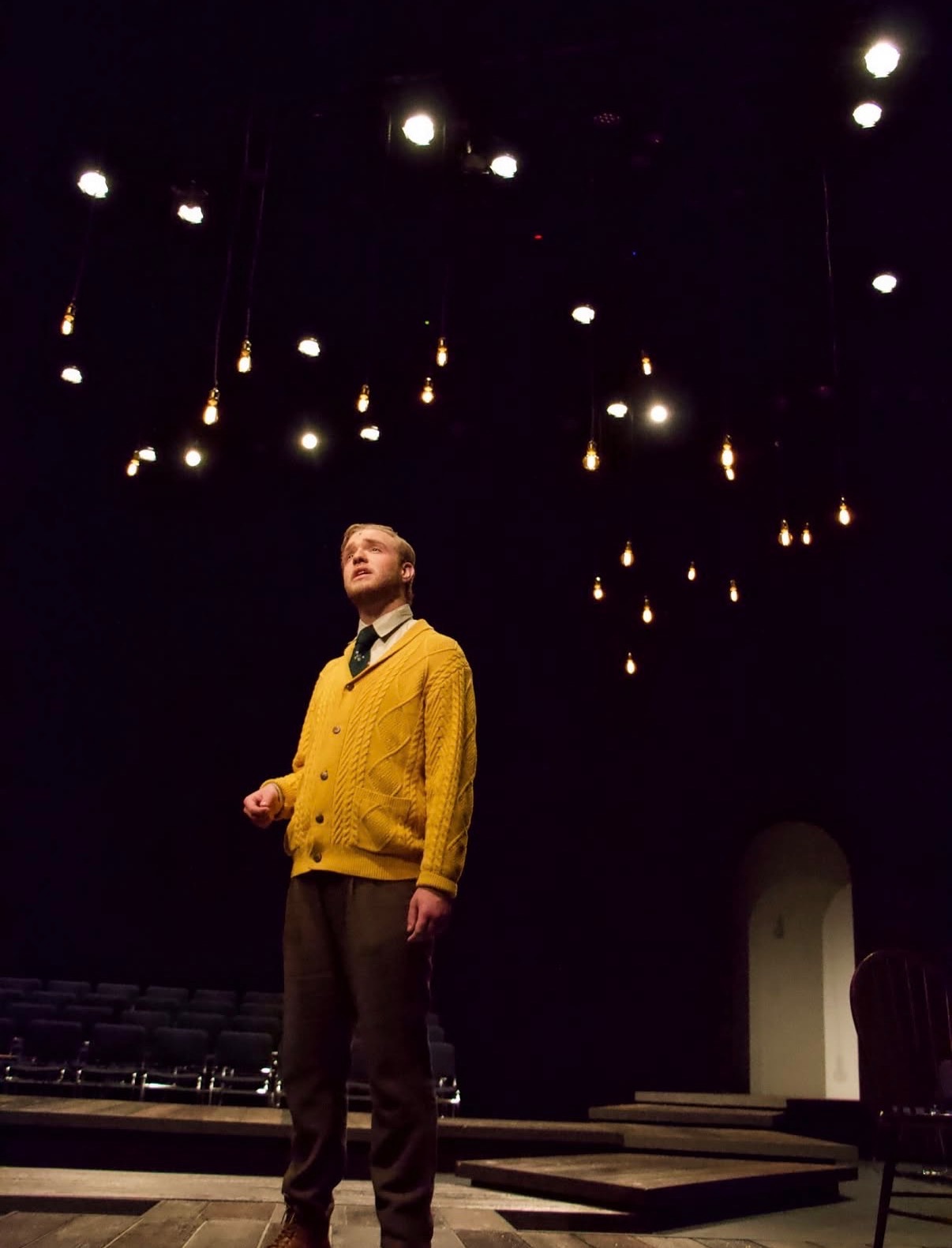
Samford University’s production of “Our Town”, which ran from Thursday, March 19 through Sunday, March 22, offered a resonant interpretation of Thornton Wilder’s classic play.
At the center of the play is Cade Harkness as the Stage Manager. His conversational performance served as the audience’s guide through Grover’s Corners. Harkness approached the role with restraint and clarity. His direct address to the audience felt natural and created a sense of intimacy that carries throughout the performance.
The emotional aspects of the play rest with the Gibbs and Webb families. Hannah Jahraus brings warmth and sincerity to Mrs. Gibbs, while William Sabonis-Chafee’s Dr. Gibbs offers a composed and sincere counterpart. Ezra Torres delivers an emotionally moving portrayal of George Gibbs by capturing both the awkwardness of youth and the gravity of his later moments.
Savannah Robin’s Emily Webb stands out as one of the show’s strongest performances. Robin balances intelligence and optimism in the early acts before shifting to a more vulnerable tone in the final act. Her performance in the final act is particularly moving because it underscores the play’s discussion about how rarely people appreciate life as they are living it.
Supporting performances strengthen the production even more. Alexa Brownlee and Colton Dearborn portray Mr. and Mrs. Webb with natural chemistry, while the broader ensemble contributes to the production’s grounded presence onstage.
The show was directed by Jordan Rehm and Chelsea Reynolds Nicholson, whose vision allows the play’s simplicity to become one of its greatest strengths. Their direction is clear and intentional, and the result is a production that feels intimate and emotionally honest.
The design choices are similarly effective. The set remains largely minimal, relying on lighting, blocking and the actors’ physicality to establish space and transitions. This approach aligns with Wilder’s original intent and encourages the audience to engage more actively with the story.
One of the most distinct elements of the show is its use of a cappella, human-produced sound. Rather than relying on recorded effects, the cast creates ambient noise and musical moments live. This choice adds a layer of immediacy and underscores the communal nature of the performance. It makes the world of Grover’s Corners feel both intimate and alive.
“Our Town” does not typically rely on spectacle, and this production embraces that restraint. Instead, it builds toward a quiet but lasting impact, prompting reflection on the passage of time and the often-overlooked significance of everyday moments.
Samford’s “Our Town” remains faithful to Wilder’s vision and also offers a fresh, human-centered interpretation that lingers after the show is over.
Staff Reporter